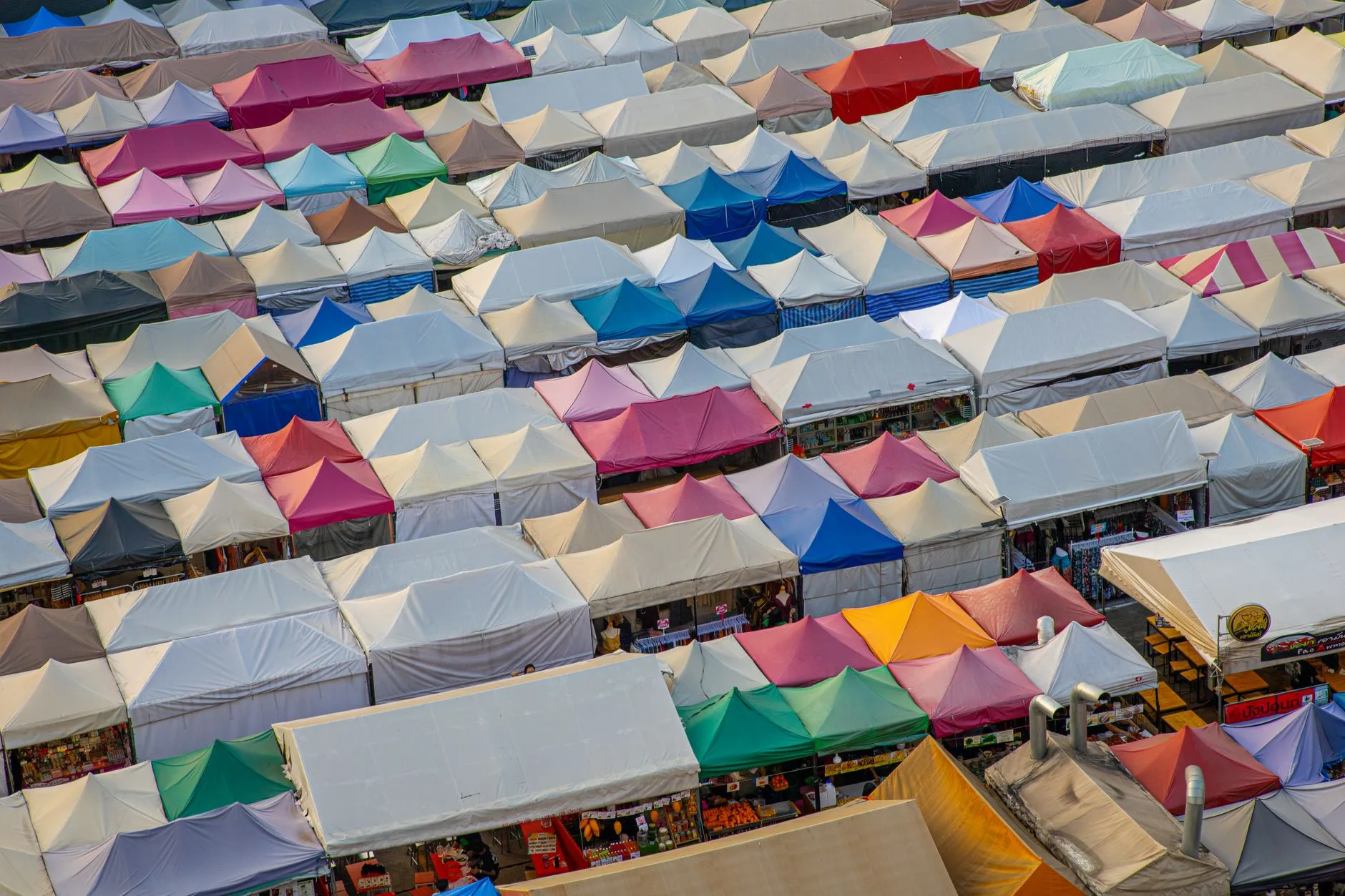
The fair ran one day on public roadway
Folsom Street is a 501(c)3 non-profit arts and culture organisation. It produced the 43rd Folsom Street Fair on Sunday 27 September 2026. The public window ran from 11 a.m. to 6 p.m. The footprint covered Folsom Street between 7th and 13th Streets, plus 8th, 9th, 10th, 11th and 12th Streets from Howard to Harrison, and Dore Street from Howard to its end.
That footprint is twelve blocks. Folsom from 7th to 13th is six. The five cross streets from Howard to Harrison add five. Dore adds one. The About Folsom Street Fair page states that since 1984 the event has been the largest of its kind worldwide, and that 2026 is the 43rd annual celebration. The About Folsom Street page states that the organisation has given over seven million dollars in proceeds to nonprofit LGBTQ2S+ centered organizations since 1984.
The build clock gave exhibitors three hours and 45 minutes
The 2026 exhibitor instructions carry the operator's own clocks. The fairgrounds opened to walk-on exhibitors at 7 a.m. Setup had to be complete by 10:45 a.m. The gates opened at 11 a.m., fifteen minutes after that deadline.
Vehicles faced a tighter clock. Driving exhibitors were assigned one of two gates and one of two entry hours, the 7 a.m. hour or the 8 a.m. hour. A vehicle had to be in the check-in line by 8:50 a.m. A vehicle out of line was counted a no-show, and its reservation was cancelled without a refund. Every vehicle had to be off the fairgrounds by 9:30 a.m.
The two vehicle gates were Folsom at 7th Street and Folsom at 13th Street. Spaces on Folsom between 7th and 10th entered from 7th Street. Spaces between 10th and 13th entered from 13th Street. The four published assignment lists carry 230 numbered spaces, 118 in the 7 a.m. hour and 112 in the 8 a.m. hour.
Two rules narrowed the build. Electricity was not provided. Gas generators and amplified sound were not permitted.
The health operation ran across the same footprint
The fair's public health and safety page sets out the on-site operation for the edition. It lists touchless hand sanitizer, hands-free drinking water dispensers throughout the fair, and masks at the information booths. It states that more space for distancing came from an expanded footprint and stage modifications. The Department of Public Health was onsite.
The page states that masks were provided and recommended, and not required, under the city guidance it cites. It recommends k/n95 masks.
The fair map carries a DPH/SFCHC shape alongside the vendor rows. That places the department and the San Francisco Community Health Center on the grounds. The map also carries four gates, labelled Gate A through Gate D, and the exhibitor instructions name the main gate at Folsom and 7th Street. The operator publishes no health village.
The same map carries seven stage shapes, among them the Bondage, Center, Folsom Live, Playground, Real Bad x 1015, Steamworks and Stud Drag stages, plus a wrestling ring. Five ADA seating areas sit on the map. The FAQ's own count is seven community stages.
Teardown finished 90 minutes after sales stopped
Sales ended at 6 p.m. sharp. Teardown began at 6 p.m. and had to be complete by 7:30 p.m. Vehicles re-entered the footprint only when SFPD and event security judged entry safe, which the instructions put at around 7:15 p.m.
End to end, the operator's day ran from 7 a.m. to 7:30 p.m., twelve and a half hours. The public window was seven hours inside it. The footprint sat clear of exhibitor vehicles from 9:30 a.m. to about 7:15 p.m., nine hours and 45 minutes.
What the clocks give a property team
The operator ran a full event build, a seven-hour public window and a full teardown in one day on public roadway. The working numbers are published. A setup window of three hours and 45 minutes ended 15 minutes before the gates opened. Vehicles had to be off the footprint by 9:30 a.m. Teardown had 90 minutes.
Access inside the footprint stayed constrained all day. The instructions bar vehicles from the fire lanes, except those in motion. The operator publishes fourteen accessible parking spaces, four at Howard and Dore and ten on Harrison at 8th, 9th, 10th and 11th Streets. The fair headquarters sat at 1401 Folsom, where the safety team was stationed and the lost-and-found line ran at 415-552-3247. Items left at the fair wait until the Wednesday after it.
The published rate context for the date is a market read. Engine gives San Francisco a citywide average of $165 a night across 3.1 million par-rate observations from May 2024 to April 2026, with September at $192. The publisher's own month table puts that 16 percent above the city average, and the page states that its observations come from searches made 10 to 180 days before check-in.
The operator also publishes a room block. Its travel page links a booking at BEI San Francisco, a Trademark Collection by Wyndham property at 50 8th Street, under group code 260925FOL, with check-in on 25 September and check-out on 28 September 2026. That window is three nights, Friday to Monday, and it covers the fair Sunday. The rate sits behind the booking flow.
The operator publishes these scales for the day. A seven-hour public day. Seven community stages. Twelve outdoor bar locations across eight venues. Four gates. Two vehicle gates and 230 numbered exhibitor spaces. Fourteen accessible parking spaces. The fair publishes no attendance figure and no capacity figure.